BEING JOHN MALKOVICH
When the desire to change life becomes a reality
Rosalie Boisvert, Maria Samantha Canson, Scott Cairns & Skyler Cameron
Rosalie Boisvert, Maria Samantha Canson, Scott Cairns & Skyler Cameron
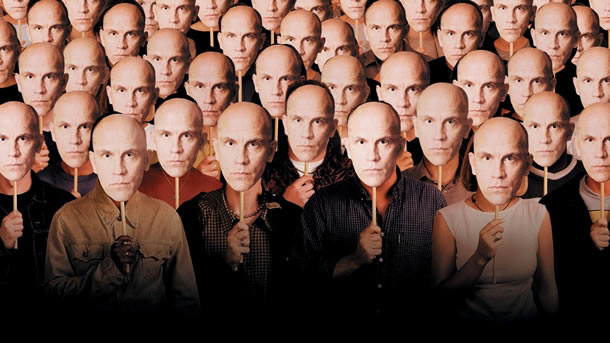
The movie “Being John Malkovich” was released in 1999. While Charlie Kaufman was the screen-writer, Spike Jonze was in charge of directing it. The lead actors are John Malkovish, John Cusack, Cameron Diaz and Catherine Keener. The film lasts for one hour and fifty three minutes (1h53) (IMDb)
Here is a trailer of the movie itself:
FILM ANALYSIS
“Being John Malkovich” is a movie that tells the story of an unhappy puppeteer named Craig Schwartz who miraculously finds a portal that leads him inside John Malkovich’s body after having taken a part-time filing job for Dr.Lester. Along with other citizens, he finds comfort in being Mr.Malkovich as it allows him to escape his many problems. Quickly, this opportunity to share another one’s body turns into a nightmare as a love triangle forms between Craig, Lotte (Craig’s wife) and Maxine, one of Craig’s colleagues. Being Malkovich becomes an obsession for many people, especially Lotte and Craig who had both developed strong feelings for Maxine. The couple both use Malkovich’s body as an intermediate to their love story with Maxine. As everyone fantasizes being Malkovich, another problem is raised as this vessel is actually essential to some individuals survival and Craig has to renounce being in the skin of the actor to save these people from dying later in the movie.
According to the John Golden "Introducing Cinematic and theatrical Elements in Film", filmmakers use different techniques to convey something precise. They want to deliver something to the audience that is specific (Golden 9). "Being John Malkovich" is no exception to the rule. We decided to analyse 5 different cinematic techniques used by the director and his crew: editing, framing, sound effect, sets and costumes. We also analysed three themes that were recurent in the movie.
EDITING
Point-of-view editing is used quite often in the movie “Being John Malkovich”. According to the John Golden article on cinematic and theatrical elements in film, this technique may be chosen by the director and his crew to show the perspective of the world through the eyes of an individual (Golden 12). “Being John Malkovich” shows people being able to bring their mind inside John Malkovich. This technique shows the audience what people such as Craig and Lotte can see when they are in John Malkovich’s body. It helps the audience to understand what the experience feels like because if one would only get a description without images of the experience, it would probably be confusing and difficult to understand. This technique also leads the audience to understand what one may feel being in another one’s body and what it may be like to have another perspective of the world. The characters can see through the eyes of another man as if they were sitting in the theatre watching a movie. They get to experience the life of another being for 15 minutes.
 |
When anyone else than John Malkovich goes through the portal, they see through the eyes of the famous actor. This is a point-of-view editing.
|
A fade is used as a transition to show 7 years have passed between two scenes. As Golden (12) explains, a fade is a way to connect scenes together that convey that there is a lapse of time between both scenes (Golden 12). As a fade is quite soft, it shows, somewhat, a time of peace. The action is done at this time of the story as it is more like a conclusion to the story. Therefore, using a fade also shows the softness of what is left to see in the movie and brings the idea that heavy action scenes have all been shown. The fade separates the scene where Craig is left alone after Maxine and Lotte leave together and the scene where Malkovich’s body reunites with an old friend. It may be understood by the way Malkovich is dressed that the actor does not have control over his body anymore. Therefore, it can be understood even at first sight that Dr. Lester and his friends were able to enter John Malkovich’s body. Both scenes occur 7 years apart from one another. This technique may also convey a sense of mystery as the audience does not know what happened in the past 7 years. After the fade, it is like if there were part of the puzzle missing and it brings the audience to make its own interpretation of the ending. For instance, when Craig is left by Lotte and Maxine, he is sad because he is left with a life that suites him even less than what he had at the beginning. As the fade, announcing 7 years have passed, occurs at the end of this scene, the audience is left not knowing what happened to Craig and the other characters in the meantime. This brings mystery.
FRAMING
The director and his crew have decided to include close-ups during the scene of the dinner with Maxine, Lotte and Craig to show the feelings of the characters. Craig and Lotte both feel madly in love with Maxine. During that dinner, they both try to charm her in their own ways and as close-ups are used to both of them, the audience can acknowledge the sparks in their eyes. As for Maxine, the spark is not as present, which is also extremely important to the story. The absence of romantic feelings in her eyes shows her dissociation from Craig (especially) and her disinterest in Lotte, when Lotte is Lotte. As Maxine explains, she really likes Lotte when Lotte is Malkovich, which shows why Maxine may have more sparkles in her eyes doing those moments, and not in this scene when Lotte is in her own body.
At the end, a long-shot is used when the audience sees Lotte and Maxine dancing at the pool through the eyes of Emily. It is at that precise moment, the audience realises Craig is trapped into Emily’s mind. A long-shot is used in that scene to convey the image that Lotte and Maxine are not aware of Craig being inside Emily’s body. Lotte and Maxine are so happy and in love that they do not see the second pair of eyes seeing through their daughter’s eyes. Thus, this framing shows a distance representing both parents 'ignorance of the truth and the unbridgeable distance Craig will forever have trapped inside Emily and separated from Maxine.
SOUND
The use of internal diegetic was used often in the movie. According to John Golden’s article, this technique is used when a director wants the audience to hear a character’s thoughts (Golden,14). As the characters got to be Malkovich, the use of internal diegetic was made for the audience to understand the feeling one may have of being this actor. The audience can hear the characters’ thoughts when they are inside John Malkovich’s body. However, Malkovish’s thoughts can never be heard when his body is the home of another mind. For instance, when Lotte is inside John Malkovich’s body, the audience can hear her thoughts, but not Malkovich’s ones. As she thinks and expresses what she feels, the audience understands what it might feel like to be inside another one’s body. Lotte is able to feel as if Malkovich’s body was connected to her brain. The audience understands this experience more than just witnessing life through another beings eyes, it is feeling what another human feels.
Non Diegetic sound which is a sound that is not part of the scene itself according to the John Golden article was as well used in the scene where Maxine has an intimate encounter with Malkovich (with Lotte being inside him).
The sound is the one of a beautiful music that is calm and that conveys happiness. The music is quite simple and the audience can predict both characters will likely pass a nice and uncomplicated moment together.
This technique is used to show the happiness of the scene and that something is occuring between the two ladies. Something funny about that scene is that the music stopped in an instant when Maxine pronounces the name of Lotte in front of the actor. He is confused and the stop in music was used to show the discomfort conveyed by this scene. The music started again when the discomfort between Malkovich and Maxine was dissipated.
SETS
One of the interesting settings for us is the New Jersey turnpike, where the bodies of the people who get to experience being in John Malkovich’s vessel get dumped after the experience. Just on a highway, being dirty, and being back to your own self. This basically means that happiness isn’t always consistent, that after every happiness, there’s also the real world, that can be filthy, and full of pain.
Another interesting setting for me is Craig’s workshop, where he gets to be himself. He gets to be creative, and be beyond his capabilities compared to when he’s just at his home or at work, where if something happens, he couldn’t really control or manipulate the people and the environment. This illustrates that in Craig’s workshop, he feels like he can be more of what he thinks of himself, which he is not really confident about when he’s in public. He may think he is talented, and he may showcase it in public, but it’s not the same as when he is in his workshop, where he is free to express his real self, which results in him exploring more ideas, and prepare for something better. Plus, he can manipulate the puppets of the people in his life and the setting where he wants them to be.
COSTUMES
Costumes are extremely important with the puppets as they identify them. Craig’s puppets are dressed like him, Lotte and Maxine. They may be identified through their clothes, hair and eyes. It is crucial to be able to recognize them as they protray whatever Craig’s emotions or fantasies are .
Maxine, who is really classy in the way she dresses, always makes an effort to put on make-up, wears nail polish, heels, and simple but elegant dress. Her hair is also neat, and short meaning she really cares for her appearance, and is not depressed. She likes it when people find her attractive and tries to always look at her best.
 |
| Here is a puppet representing Maxine |
THEMES
First theme of the film Being John Malkovich is Man vs Himself. It is connected to the film by Craig being torn between choosing to be himself and make something out of it or be inside John Malkovich’s body and experience the life he always wanted to have.
Second theme of the film is Identity. As we saw in the film, everybody had questions about their real identity. Everybody seemed confused, miserable, and impatient. They are so desperate to know their real identity that they need to invade someone’s body to feel like themselves even though it’s weird because you could not be yourself if you’re not in your own skin.
Another theme of the film is Love and its tragedies. In the movie, we saw how Craig and Lottie we’re failing at their marriage, Craig being in love with Maxine, and Maxine being in love with Lottie. We also saw how tragic the event was when Craig knew that after all the time they were together in John Malkovich’s body and despite all the success they’ve made, Maxine was just plainly in love with Lottie.
(1819 words)
OPINION OF THE MOVIE
⭐⭐⭐⭐
We found the movie was quite interesting and captivating. However, it was bothersome to us that some questions were not raised nor were they answered.
We really like the use of costumes in the movie. For example, when one mind is controlling a specific body we found it to be quite an interesting reference and makes the story easier to follow. We also like the puppet reference that foreshadows the rest of the story as Craig gets to control another one’s body as he does with his puppets. We thought the storyline was well planned as details were present, but we found there were some holes to the plot of the movie. For instance, we do not understand the 7 ½ floor. It is explained in the movie, but Maxine states it is a false story and the audience does not get any other information besides what the introductory video that is played for those who start working at Lester Corp (the company which occupies the 7 ½ floor), conveys. Even if what the video says it’s true, it does not explain the importance of that irregularity in the size of the floor to the story. We found it was a funny fact, but we felt confused watching the movie as we were waiting for evidence explaining somewhat the importance of this detail.
We thoroughly enjoyed the complex characters we were given with this movie. We feel it is important for a movie to talk about the mind to present characters that are not simple as it makes their mind more fun to explore. For instance, Lotte was changed by her first experience of being Malkovich. She changed many aspects of her life such as her sexual preference and her identity as she felt more like a male. Maxine changed her perception of what she looks for in someone in which she wants to pursue a relationship with. At the beginning, she focused more on the appearance (she liked Lotte, however, only when she was in Malkovich’s body), but gradually changed her opinion (she began to like Lotte for who she really was). This was also an interesting process to follow.
In its entirety, we really liked the movie “Being John Malkovich” and we would definitely recommend it to our friends and family as we know they might take an interest in watching the film. We find the movie is well structured and original without being absolutely absurd.
 |
| 7 1/2 floor |
CONNECTIONS TO THE COURSE CONCEPTS
1) In “Being John Malkovich” metaphysics is a concept that is explored. According to the study guide, metaphysics may be defined as “the study of reality” (McKinney 19). In “Being John Malkovich” .In the movie, this philosophical concept is explored through the fact that people get to be John Malkovish. As they go through the portal, they enter the skin of the actor and begin to see the world and feel it through another body. This raises the question of the connection between the body and the mind, a metaphysical question. Is there a connection or not?
As Lotte travels into Malkovich’s body, she feels the way he feels but does not control his movements. Therefore, the connection between the mind and the body may be interpreted as stimulus that connects the body to the mind. The idea a body may hold multiple minds is also conveyed in the movie as when people travel through different bodies, they share it with the original mind of that individual. For instance, Malkovich still holds his own mind when Lotte shares his body. When he encounters Maxine, he has his own independent feelings towards her. However, as Craig shares his body, a competition between both minds seems to be occurring as only one controls the body at the time. It is therefore difficult to draw the line specifying the connection between the mind and the body as it is different depending on the situation. What can be affirmed though is that minds can travel through different bodies. The body may therefore act as the home of the mind.
The question of the immortality of the soul is also introduced in the movie as Dr. Lester explains to Lotte the reason why he changes body through vessels is to stay immortel. This individual is quite old, but has been changing bodies to avoid dying. Therefore, the movie may convey the idea that a soul does not die as long as it is part of a living organism. When the day has come to go through the portal, if travellers don’t pass through they risk death. This is what affirms Dr. Lester in the movie. As long as the mind has somewhere to reside, it stays alive.
Finally, the movie also conveys the idea that the world is not only material. In fact, “Being John Malkovich” concentrates in exploring the mind of an individual. Bodies are only the box in which the mind resides. As mentioned earlier, the body may die without the mind dying, but if the mind dies, it is likely to say the body will die too. Therefore, the mind may remain as the material die.
2)The film introduces the concept of experiential consciousness which is a “phenomenal or experiential consciousness” according to the course package (McKinney 6). In other words, this type of consciousness is present when “there is something to be like” (McKinney 6). This relates directly to the film as “being John Malkovich” is something. People are ready to pay a lot of money to experience being someone else. People get to know what is it like to be John Malkovich. They get to feel what he feels and to see what he sees.
The concept of experiential consciousness is also tackled abstractedly through the concept of puppets. Craig, who seems to be highly unhappy with his life, uses his theatre of puppets to imagine what his life could be. As he imagines his ideal life, he has experiential consciousness as he experiences momentary being another individual. The puppet master claims during a class (while he was in Malkovich’s body) that a good puppeteer must be able to feel what the puppet feels which means he himself felt what his puppet was feeling when he was recalling his “perfect life”/phantasm. He then had experiential consciousness. There was something to be like his puppets.
 |
| This is one puppet theatre Craig uses to express his life or what his dreams are. |
3) We can link the movie “Being John Malkovich” back to the subject of sex robots which we covered in class. We can see that John Malkovich is an actual human being, but at the same time, people have the capability of controlling him. The portal gives anyone who uses it direct connection to John’s mind. Not only that, but later in the movie we see that people who are now able to stay in John’s mind (i.e Craig) can basically use him as a robot for sexual pleasure. For example, Craig stays in John’s mind and uses John’s body and physical appearance to attract Maxine and ultimately he uses this for sex. The fear of sex robots becoming a word-wide phenomonon is real. People would be able to abuse their power against these robots and this could translate into real world issues. For example, people who purchase these sex robots will have the power to be pleased sexually whenever they want by them. Who is to say that this will not cause people to be more prone in abusing their power, only this time using real humans to please them sexually. In the movie, we see just that. Craig abuses the power of accessing Malkovich’s body to please himself with Maxine. Essentially, Malkovich is the sex robot and we see that people go crazy over this idea of being able to access his body and they pay crazy amounts for just 15 minutes of “fun”. (McKinney, 49-58)
INTERESTING QUESTIONS TO THINK ABOUT
1)What makes you "you"? Is it both your mind and body? Only the mind? Only the body?
2)What motive would lead you to exchange your body/life with someone else’s for 15 minutes (or more)?
3)One of Craig's motives to change body is to get a better life. He is highly unhappy with his life. He did not get to live his "perfect" life at the end, but he did get a small part of it when he got to be Malkovich for a couple of months. Do you think his short experience being Malkovich and fulfilling his dreamjob for that time was enough for him to be happy? Do you think Craig ended up being happy afterall? If not, do you think he ever could have been happy using another ones body on a long time scale?
WEB-LINKS THAT ARE LINKED TO THE MOVIE
Identity is an important theme in the movie “Being John Malkovich”. It particularly applies to Lotte who really questions herself about her identity after experiencing being inside John Malkovich. This article explains the idea of Identity and Identity crisis.
The pursuit of happiness is an important theme in the movie “Being John Malkovich”. In her TED talk, Katarina Blom explains her point of view on happiness and how it might be developed. She emphasizes on the fact that humans tend to concentrate on the negative aspects of their lives or situations. She says happiness can be “found” (she does not use that word) through important relationships which is directly linked to the movie as the characters at the end found their happiness through relationships (Maxine and Lotte & Craig that lives with both of them).
References:
- “Being John Malkovich” directed by Spike Jonze, NBC Universal, 1999.
- “Being John Malkovich”. IMDb, 1999. https://www.imdb.com/title/tt0120601/.Blom, Katarina. "You Don't Find Happiness, You Create It".TED: Ideas Worth Spreading, May 2018, https://www.youtube.com/watch?v=9DtcSCFwDdw.
- Cherry, K., Morin, A. "Identity Crisis: How Our Identity Forms out of Conflict." VeryWellmind, 31 Oct. 2019, https://www.verywellmind.com/what-is-an-identity-crisis-2795948.
- Golden, John. “Introducing Cinematic and Theatrical Elements in Film.” Teach With Movies, http://teachwithmovies.org/.
- McKinney, Kelly A. “Humans and robots are on the cusp of a sexual intimacy we may never reverse” Knowing the Inner Self, John Abbptt College, 2019, p.49-58. Course Pack.
- McKinney, Kelly A. “Philosophical Terrain.” Knowing the Inner Self, John Abbptt College, 2019, p.19. Course Pack.
- McKinney, Kelly A. “Study Guide on Consciousness.” Knowing the Inner Self, John Abbott College, 2019, pp.3-7. Course Pack.
Juliette Gennaro
ReplyDeleteI would like to answer: “What motive would lead you to exchange your body/life with someone else for 15 min (or more)?”. To that, my answer would be that knowledge would be my motive. I would like to exchange my life with someone living in poverty for a minimum of 15 min to be able to understand the reality of what is going on in the world and face it. I feel like hearing about poverty doesn’t shock people enough to want to try and make a change. I believe that if I had the chance to experience what it is like to fight for my life, I think it would educate me and make me more conscious of the huge problems our society is facing. Knowledge is power. I do believe that the more you know about a subject, the greater opportunity you have to make a difference and thus make our world a better place.
I agree with what Juliette said about question #2. I would also exchange my life with someone for knowledge. I agree with what she said on poverty, I believe it would be very humbling to see the different perspectives a person living in extreme poverty has compared to myself, who lives in a first world country. I would also like to exchange my life with someone from a socio-centric society, since I am from an ego-centric society. The idea that, for example, American and Japanese people view the world in such a different way that we view lines and aquariums differently really intrigues me. I would like to exchange my life with someone from a socio-centric society to simply have a better understanding on what it's like to grow up in a society completely different that the one in Canada. In all, like Juliette said, I would exchange my life with someone to advance my knowledge, since knowledge, for me, is very important.
ReplyDeleteShuk-Kwun Chan
ReplyDeleteA question you guys raised was whether Craig was happy being John Malkovich or whether he was or could ever be happy. After watching the film, I think that he was more in denial of reality than he was happy when being John Malkovich. He was depressed in his real life because he felt underappreciated and unrecognized. By being in the body of the actor, he was able to momentarily escape that dejection and experience someone else’s success, so he convinced himself that he is happier and better off living the rest of his life as somebody else, especially with Maxine’s encouragement. However, throughout the eight months of “being John Malkovich,” the actor’s appearance was gradually changing to resemble more and more Craig’s attire at the beginning of the film (long untamed hair, wrinkled clothing, etc.). I think this symbolizes that even if Craig were to live somebody else’s life, he is still who he is on the inside. He is still the same self-pitying, egotistical pessimist and so he will always find flaws in his life to be sad about. Therefore, I do not think that his experience of “being John Malkovich” fulfilled his dreams and made him happy. Instead, he becomes more bitter after leaving the actor’s body because everybody around him is happy but himself. Due to these reasons, I do not think he can ever be happy in life, even in another person’s body.
Fuji Chen
ReplyDeleteI feel what makes you "you", is what you represent to others and how you feel. Almost like your consciousness is what makes who you are, but it also involves how you look and operate. Like if you where disabled, that would be a part of you even if it did not affect your cognitive abilities or your state consciousness. Such as in the movie "Being John Malkovich" others wanted to be in the body of John Malkovich because it changed who they where, even though their consciousness was unaffected, it was a part of their identity.
Genesis Lazaro
ReplyDeleteWhat motive would lead you to exchange your body/life with someone else’s for 15 minutes (or more)?
My motive is to obtain knowledge from wealthy and intelligent people for me to be able to help the people who are less fortunate. Growing up in a third world country and being in a low class family I always wanted to be rich to help my parents stop working a 9-5 job. My goal is to help the kids who stopped school due to poverty to finally go to school and repay their parents efforts. Everybody has different motives, and mine is about giving back to the community. Unlike Craig, he used another persons body for his own convenience.