EX MACHINA
Sean Watson, Giulia Viarizzo, Chloe Viel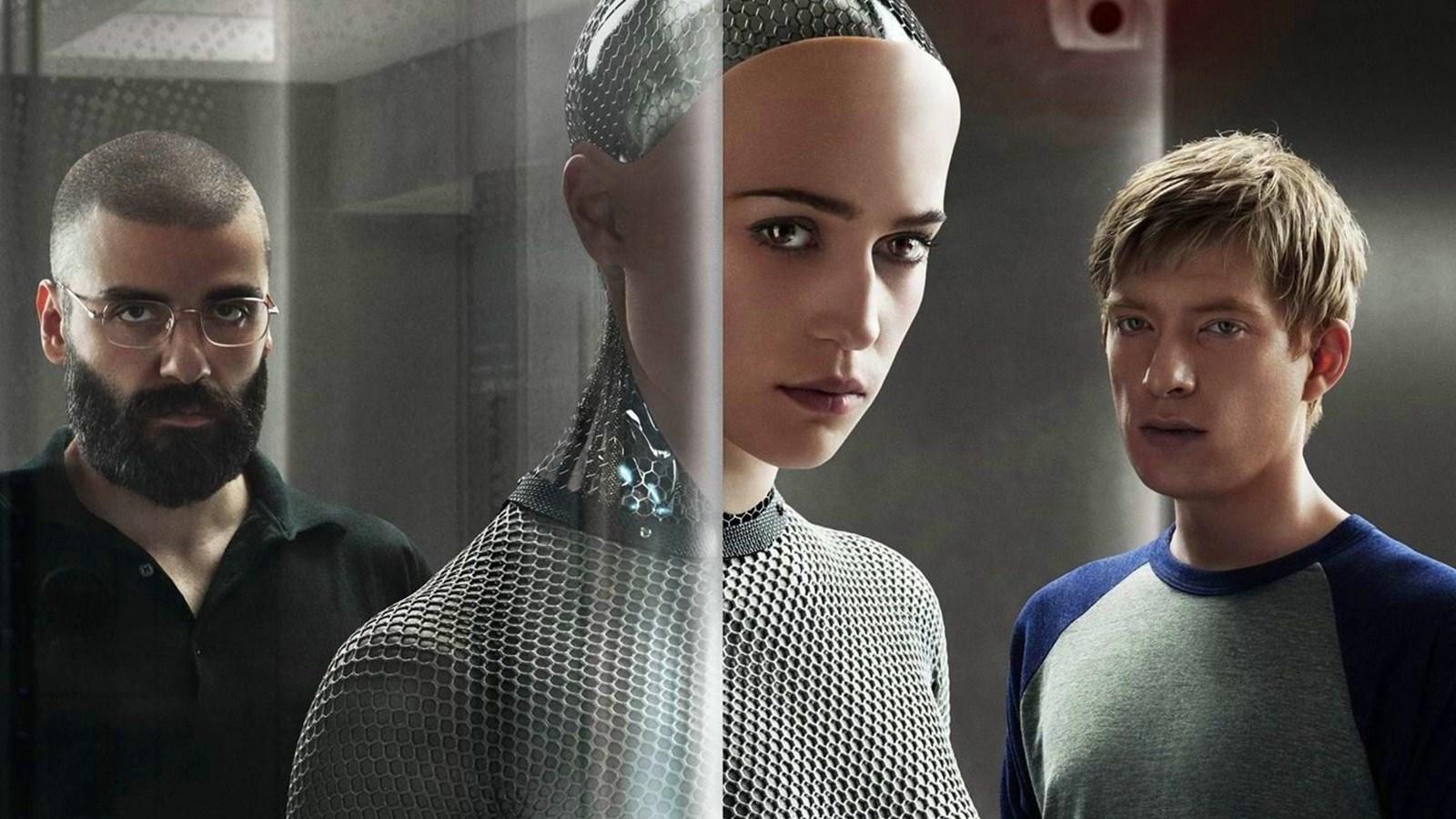
Link to trailer: https://www.youtube.com/watch?v=XYGzRB4Pnq8
Ex Machina, 2014. Written and directed by Alex Garland. Lead actors: Alicia Vikander, Domhnall Gleeson, Oscar Isaac. 108 mins. IMDB.com https://www.imdb.com/title/tt0470752/?ref_=nv_sr_srsg_0
Caleb wins a contest and moves in with Nathan, CEO of the prosperous tech firm Blue Book, at his remote wilderness lab for a week to help test a new robot creation. The goal is to test the new robot, Ava, to see if she possesses a consciousness. The Turing test, the standard test to determine if a robot can pass as a human, isn’t perfect. Nathan wants more, he wants an “average person” to interact with Ava face-to-face. Ava will pass the test if the individual, while fully knowing that Ava is a robot, still seems human. Caleb is very impressed with Ava and begins to think she has a romantic interest in him, as he too begins to develop feelings for her. Caleb confronts Nathan about this as he feels that Nathan may have programmed her to love him to 'cheat' on the test, but this is not the case.. As it turns to try to escape. She realized that the best way to go about it would be to try and seduce Caleb to get him to help her escape. Nathan knew Ava would try to manipulate the person sent to test her, so he devised a plan. He rigged the contest and used his search engine to find someone lonely and who might be susceptible to Ava's advances, enter Caleb. In the end, Ava can manipulate Caleb into helping her escape despite Nathan’s attempts to counter the insurrection. Ava gets the help of Nathan’s robot butler/sex robot to kill him and she escapes leaving everyone else (including Caleb) locked in the research bunker.

Sets:
The vast expanse of Nathan’s backyard was in stark contrast to the claustrophobic and sometimes dreary subterranean laboratory. To put people and machines on opposite sides of the glass. Ava is separated from Caleb by the glass and from Nathan by a monitor. Then when she escapes, she changes in full view of Caleb but there is an aquarium obstructing his view. Finally, she leaves him behind a glass door. The glass represents an invisible yet impenetrable division between the humans and the robots. Though humans and robots may look and act alike, we will never be the same. Additionally, the walls of the lab represent a divide between the natural and the created. Outside the lab, we see vast forests and waterfalls. A prime example of mother nature at her most unobstructed. Inside, however, there is only what Nathan has chosen and placed. Ava, Caleb, the lab, the cameras, all are there because Nathan has chosen it. All of it helps to further Nathan's agenda. The very walls of the laboratory represent the divide between the creation of nature and the creation of man. That is man's creations and not the creation of man by some deity.
Nathan’s character throughout the movie proves to be an arrogant man who wants to play God and have the total power over everything and everyone, Ava to begin with, and even Caleb. Their rooms are in fact like luxury prison cells. They are given what they need and what they want but they can never really leave. Ava is locked in her room/cell and Nathan is confined to a small area around the lab only accessible by helicopter. On the inside, things seem nice for Caleb. He can roam semi-freely. Enough to make him feel free but still limited so that Nathan can control what Caleb has access to. Ava can’t go out, Caleb can but when power cuts occur, he is locked inside. On top of that, they don’t have windows, as Calebs points out. These locations are the representation of their lack of freedom and Nathan is their jailer. As mentioned above, everything inside the lab is thereby the direct will of Nathan. He has created his world, his maze, in which Caleb and Ava can roam, somewhat, and, maybe, escape.
Props:
The key cards show a silent dynamic of power, Nathan designed it in such a way that Caleb could explore without asking yet still be told what he could and could not do. The cameras enhance that effect to the point that both Caleb and Ava are always under observation by the God figure Nathan, always in control of the situation. This dynamic comes to a climax when Caleb steals Nathan's key card to gain access to the control room and change the locks so that when the power fails, the doors open. This dramatically changes the dynamic of power as Caleb now controls the lab. He who holds Nathan's card controls the lab and everything within it.
The drawing is an important object because it appears more than once and first, it seems to be a mean for Caleb to test AVA’s creativity (and if she has one), but then it becomes “an illustration of my cruelty to her and her love for you”, as Nathan says to Caleb. In fact, AVA drew a portrait of Caleb showing her affection by choosing him as the subject of her art, but the Nathan cruelly tore it up in front of her so that Caleb could see the scene through the cameras.
Editing:
Cross-cutting is used in the first scenes of the movie when, in an office, everyone is working or chilling. These shots are meant to make the viewer know what is happening in different areas of the building and, as all the people are calm and minding their own business, it suggests that it’s a normal day and everyone is just following their routine. The last shot of the sequence frames the protagonist and the audience can assume that the story has come to a turning point.
In the fighting scene among AVA, Kyoko, and Nathan, it’s used a sequence of short takes that give rhythm to the action scene. Several short-lasting shots that move from AVA to Nathan then to Kyoko makes the scene more chaotic and the fight more realistic and intense.
Framing:
Close-up: After the third session, when Caleb starts questioning himself about his feelings towards AVA, the audience can see him watching her undressing through the monitor in his room. The camera frames a close-up his eyes so that one can see his focus on her; then there’s another close-up on his throat while he’s swallowing, to highlight his reactions towards what’s going on on the screen; lastly, the camera goes back on his eyes, still busy in the observation.
Eye-level shot: when Nathan stands in front of Pollock’s painting, there’s an eye-level shot in which he is framed from the waist up and, this way, it’s created a connection between him and the painting that gives him importance. First, he explains the genius behind Pollock's art, and then he makes an analogy with how relating to AVA works.
Lighting:
Low-key lighting: when Caleb and AVA first meet, in the room the lighting is low and this makes the situation more mysterious. In the back of the room, there is a kind of window where some light comes in and goes through AVA’s robot tissues and makes stand out her silhouette of half-robot and half-human.
High-key lighting: towards the end of the movie, when AVA finally can go outside, the sunlight shines on her and marks her success. The lively and bright light represents freedom and possibility, creating a contrast to the claustrophobia and tragedy in the house.

- Ex Machina tackles the problem of consciousness. Around every turn, Caleb questions if Ava really is that smart, or just trying to cheat the game. We can’t know for certain - since we can’t live inside her head - but we have good evidence that she exhibits state consciousness and thus, is a conscious entity. We can venture this since she knows when Nathan is unable to listen in, she almost becomes a completely different person. She drops the neutral question-answer gambit and jumps straight to the point; Nathan is lying to you, you need to get me out. She also has a self-aware self since she seems to fear the concept of her ceasing to exist. She has a self-aware self since she reflects on her role in the lab’s society. She realizes that she is there to be experimented on and if she doesn’t bring the correct responses, she may be terminated.
- The film does not try to argue that machines can have the same mental capacity as humans. It declares that right from the start. Instead, Alex Garland decides to take a more radical approach to the robot debate: Can robots and AI be persons? That is, can robots ever reach a point where humans consider them people and bestow upon the machines inalienable rights and freedoms. The film argues that, if Ava can act like a human, draw, speak intelligently, love, have ideas, should she not be considered a person and therefore have rights? Ava must be more than a mere implement of Nathan’s considering her self-aware self and uncanny resemblance to humans. Her only difference is her construction. Where a heart beats within Nathan, a complex computer runs Ava. Does that make her less than us? Ava wishes to be free. She wants to walk down a busy intersection and meet people. No God “that breathes fire into the equation” (McKinney 34) and makes humans better, all conscious entities then deserve just as much as any other.
- Finally, the film rather blatantly touches on epistemology with the black&white room thought experiment. If you know something absolutely, can experiencing it teach you anything? From that we can also ask; can you truly know something without experiencing it? They can’t both be true. If Ava has learned everything she knows from mining the search engine, then, in theory, she could know everything absolutely. Then, she would have no need to break free and experience the world, the busy street corner. If this were true, she may only want to escape out of self-preservation and the protection of her rights to freedom. However, we see her desire to do these things, to meet people. Therefore, there must be something to experience. Ava would then prove that you can’t know something truly unless you’ve experienced it. (1291 words)

 We believe that this film is just alright. It raises some interesting points about robot morality: is it just to experiment on a robot in this way? Though it is interesting, it isn’t that great a movie. The film keeps you hooked throughout but by the end, there was a feeling that more was needed. Ava gets her revenge for her captivity but it leaves you wanting more. Yes, Nathan is dead, but where does that leave Ava? She now wanders the streets alone, trying to find meaning in the world. Her whole purpose was to break out of the lab. She now has nothing. Though Ava is clearly intelligent, it isn’t as obvious as in other movies dealing with robots (Blade Runner). Ex Machina also distracts from the main point of the film with Ava’s obsession with wearing clothes and trying to look as human as possible. It could have been much more interesting if the focus stayed on the arbitrary difference between robots and humans instead of implying it by making Ava look like a person.
 The film also lacks focus by bombarding the viewer with concepts only tangentially related to the main theme of robot morality. The scene in which Caleb talks to Ava about the Black&White room comes to mind. The film set out to talk about morality and has now decided to dabble in epistemology. Whether or not Ava learns anything from experience has little to do with her ‘right’ to be treated as a person. If she can think and feel, the film argues, though ambiguously, she should be treated as a person.
Yet, the film is interesting and even fun. Nathan’s plot twist near the end catches you by surprise and makes you think but the film gets distracted from its main point from the get-go and never recovers. We learn that Ava is super-intelligent and then spend far too much time with Nathan as he explains ‘science-magic.’ It really does not matter how Ava came to be, so don’t invent science to explain it. Though the ‘science’ is interesting, it again distracts from the main point. This film should more resemble a trial for Ava’s right to morality. All things should service that and that alone, only ever deviating to have a cohesive story. Ex Machina tries to do more, and in the end, does less because of it.

7. Did Nathan use Caleb’s search history to make Ava look more attractive to him and thus make his manipulation easier?
Will it ever be possible for humans and AI to coexist and break that glass that stands in between?
If a robot looks like us, behaves like us and, eventually, becomes part of our community, could it ever be considered a “person” and have the same rights despite its inorganic existence?

8.
Ex Machina Has a Serious Fembot Problem
Wired dives deep into the sexual politics of Ex Machina. Does Ava perpetuate or shatter gender stereotypes in Hollywood - the author argues the former. We see Ava act like a helpless girl while trying to get her way by seducing Caleb. If Ava were a man (or written better) things may have been different. Instead, we are left with what women always represent in Hollywood. Damsels in need of resuing AND women who manipulate men to get what they want. Quite the combo.
How ‘Ex Machina’ Foresaw the Weaponization of Data.
Popular Mechanics take a look at the legacy of Ex Machina. In 2015, there was the idea that our online data could be hacked for fraudulent purposes but never on such a scale as in the movie. Sadly, we were wrong. In the past few years, such scandals Cambridge Analytica have shown us that Ex Machina was more than just a fun Sci-Fi movie, it was a warning and a warning for something imminent.
Works Cited:
Dupzyk, Kevin. How ‘Ex Machina’ Foresaw the Weaponization of Data. Popular Mechanics. 16 January 2019. https://www.popularmechanics.com/culture/movies/a25749315/ex-machina-double-take-data-harvesting/
Garland, Alex. Ex Machina. Screenplay by Alex Garland, starring Domhnall Gleeson, Alicia Vikander, Oscar Isaac. Run time 108 mins, 24 April 2015.
McKinney, Kelly. Knowing the Inner Self. John Abbott College, 2
McKinney, Kelly. Knowing the Inner Self. John Abbott College, 2
Watercutter, Angela Ex Machina has a Serious Fembot Problem. Wired. 4 September 2015 https://www.wired.com/2015/04/ex-machina-turing-bechdel-test/
Fuji Chen
ReplyDeleteI personally don't think that AI robots will ever really "break the glass" and become more normalised in society to the point that we accept them as other humans. However, I do feel that that they will reach a point where we would treat them similarly to pets and still love and care for them, but we would be still understanding and recognising the differences between them. In class, we have talked about the "Uncanny Valley" where we would not be able to tell the difference between humans and robots, but personally i feel that it will never reach this point, as there is always something different about living beings that I do not feel robots will ever be able to represent. Like when someone is near you, but you don't see or hear them. You might not have any senses that would dictate that they are there, but we are still able to feel the presence of another human by instinct as almost like a sixth sense.
Melissa Yip
ReplyDeleteTo answer your question, yes Nathan designed Ava based off the preferences of Caleb. It was even stated in the movie when Caleb asked if she purposely resembled the women in his porn history. Nathan wanted Caleb to develop feelings for Ava, so that he may be more inclined to see her as human and thus passing the Turing test. He believed that Ava needed the extra push in order to pass, but in truth, she was already extremely self-aware. She had reached a level of consciousness much higher than Nathan nor Caleb could've imagined. She showed the capacity for human emotions and she was self-aware enough to understand the situation she was in. She fully understood that had she not reacted or answered correctly, she could've been shut down and updated. Now I throw a question back at you. Do you believe that her consciousness is truly hers? If she is made up from the searches of various people online, then she could be merely regurgitating the various sentences that she absorbed and answered specific questions using an algorithm to identify specific words, similar to those used in marketing. What do you think?