TOTAL RECALL

The load down for those who do not completely recall the important aspects of "Total Recall"
The load down for those who do not completely recall the important aspects of "Total Recall"
Sofia Prahalis, Kourosh Soleimanipak, Ivan Simic-Petrovic
Director: Paul
Verhoeven
Inspiration: Philip K. Dick’s short-story “We Can Remember It For You Wholesale”
Screen-writers:(screen-story)Ronald Shusett, Dan O’Bannon, Jon Povill
(screen-play) Ronald Shusett, Dan O’Bannon,
Gary Goldman
Lead Actors:
Arnold Schwarzenegger (as Quaid), Rachel Ticotin (as Melina), Sharon Stone (as Lori),
Ronny Cox (as Cohaagen), Michael Ironside (as Richter)
Running time: 1h
53 min
("Total Recall", 1990)

GENERAL REVIEW
Douglas Quaid, played by Arnold Schwarzenegger, is a construction worker in the year 2084 who fantasizes about visiting the colonized Mars. He visits an organization called "Rekall". This organization specialises in planting false recollections into individual's minds, to experience Mars without actually going there. Something goes terribly wrong during the procedure; Quaid finds that his whole life may be just a fake memory (i.e., a lie) and that the individuals who embedded it in his mind want him dead. Quaid then travels to Mars in hopes of uncovering the truth about his existence and to save the rebels from Cohaagen, the leader of Mars', rule. Quaid discovers that his
“wife”, Lori, is actually one of Cohaagen’s assassins that she was sent to keep a close eye on him. After finding out that his whole life was a false
memory, Quaid starts his quest alongside Melina, his rebel-lover, to find out
who he really is, why Cohaagen is after him, and finally to help the rebels
repossess their air by starting up the reactor. Throughout his journey, he also questions everything that
surrounds him and the essence of reality as well.

FILM TECHNIQUES
Several cinematic techniques in the film enhanced its effectiveness, including sound, lighting, sets, props, and characters. Here are a few techniques and examples that greatly strengthened our appreciation of the film.
SOUND
Ex1.) Diegetic
Sound: Gun shots
This type of
sound “emanates from a source in the movie environment” (Golden,13). In this
case, the diegetic sound comes from gun shots during the many fight scenes, and it enhances the viewers
experience by adding on more action (loud, fast-paced noise) to an already action-packed
film.
Ex.2) Non-Diegetic Sound: Quaid strapped into chair
Non-diegetic
sound “can be the music we hear while the title is rolling” (Golden, 14). In
this scene, Quaid is fighting his way out of the chair that has him buckled down in metal handcuffs and his time is running
down very fast. The intense and fast pace music playing in the background is adding on to
the anxiety the viewers are already experiencing.
LIGHTING
Ex.1) High-key
lighting: Kiss between Quaid and Melina
With scenes
shot in this lighting, “characters’ motives are not hidden, nor are there
likely to be any scares or sudden surprise” (Golden, 14). This was a very light
and happy scene where the two characters shared a kiss without any ulterior motives
other than wanting to proclaim their love for one another. This scene represented a very classic cliched Hollywood lightning and ending.
Ex.2) Front-lighting: Quaid being cornered by four men wanting to capture him in a public space.
Ex.2) Front-lighting: Quaid being cornered by four men wanting to capture him in a public space.
In this scene,
Quaid is “brightly lit, without any shadows appearing anywhere” (Golden,15).
This has the effect of proving he is the hero in the plot and it is showing his
“pureness and honesty” in this situation (he has no idea what is going on)
(Golden,15).
SETS
Ex.1) Underground Alien machine
The large underground alien machine scene uses a lot of old and rusty props and adds rusts to giant pillars with CGI to express just how old the machine and ruins really are.
Ex.2) Mars
Stepping foot
on Mars, let alone creating a civilization on it, has not yet been done. Centering the story on Mars obviously indicates that it takes place in the future, which is reinforced when the viewer learns it is the year 2084.
PROPS
Ex.1)
Underground mining drill
Though this
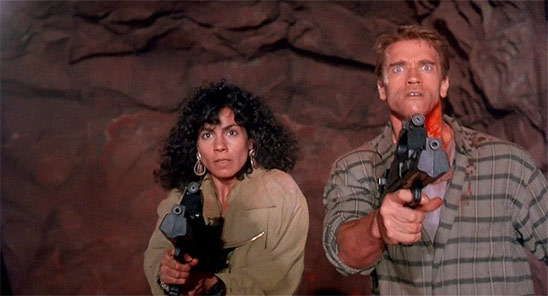
prop seemed pretty insignificant and inocuous in the beginning of the film, it's appearance then foreshadowed what was to come. Rather than just a piece of mining equipment, it became a killing machine, and played an important part in creating one of those most exciting and nerve-wracking scenes in the film: when Quaid and Melina fought for their lives toward the end of the film. Using
his superior strength, Quaid cut the pipe containing the fuel for the drill, pulled off a
piece of it, used it to stab Benny and then Quaid and Melina were able to escape.
Ex.2) Chair in
which memories are erased and new memories are implanted (wrist straps on first
and metal ones on the second one)
In the scene where
Quaid is being attached to the memory implantation chair for the first time, the flimsy straps around his
wrists are clearly shown. At first, this detail is minor but as the story
progresses and Quaid is attached to the same type of chair to erase his memory against his will, the straps around
his wrist are firm and metal. This shows the difference between him willingly
inserting fake memories into his brain and him being forced to
get his brain erased.
CHARACTERS
Ex.1) Quaid
The character of Quaid needed to be played by a tall and very muscular man (Arnold) to portray his bravery and extraordinary strength. Quaid is proud, a hero fighting for the underdog, as well as sensitive and caring. Therefore, this
character was made to be the “perfect man” that can fight off evil and save a
planet in need of help.
Ex.2) Lori
Lori, played by Sharon Stone, is athletic, sexy yet sweet and beautiful. These qualities made it
very easy for her to live a double-life. Looking as innocent as she did, made
it quite easy for her to keep Quaid close and not at all suspicious (as well as the audience). On the
other hand, her athleticism allowed her to fight off opponents, Quaid
included.

ISSUES & BIG QUESTIONS
This film addresses issues with capitalism. The film takes place on Mars which is being run by capitalists and private corporations. In a way, the film is mocking this way of governing in order to show what society would look like, and what it has to deal with when it is under a capitalist authority. A super important question this film asks is how might we differentiate between reality and dreams? What makes us, our memories, our past, regardless of whether we don't recall it, real? Quaid couldn’t tell if he was dreaming or not, even at the end he says “I just had a terrible thought: what if this is a dream?” doubting reality. Another question/theme in this movie is, who am I? Throughout the film, Quaid was told many times who he once was, who he is now, and who he will always be. All of these perspectives on Quaid's identity which are coming from outside sources had lead Quaid to often question his identity in general( who is he?, what is his purpose?, is he good or bad?).
("Total Recall", 1990)
WORD COUNT: 1060 words
In all honesty, action films are not our favourite genre of film, therefore we would not watch it again. Even though we didn’t particularly love the plot and the science-fiction in this movie, we did appreciate many of the cinematic techniques and some one-liners recited by the characters.
Seeing as this movie was made in 1990, we found the futuristic elements used to be quite fascinating. The idea of having a skeleton X-Ray machine as well as, self-driving taxis are quite fascinating and shows a lot of “forward-thinking”. In addition, the use of the hologram added a very interesting element to the film seeing as it was both futuristic and made for a great distraction. It was also just plain silly! Furthermore, in that same scene, Quaid faked using the hologram and said “Hahaha, you really think this is Quaid?” (Verhoeven, “Total Recall”). The assassins lowered their guns and looked to each other in a confused manner. Quaid stated: “well it is” and proceeded to kill them all. Finally, the last line where both Quaid and Melina question whether this is all a dream left us mind-blown and with a slight smile on my face. For the next hour, we replayed scenes from the movie in my head in hopes of figuring what was real and what was a dream. The last line was very open-ended and left us questioning almost the entire movie.
On the other hand, we found many flaws in the science aspect of the film, which we did not enjoy. For example, if the alien machine only made oxygen, the humans would still die because we can only survive in an atmosphere like that of planet Earth's. (For those wondering, the Earth's atmosphere contains 21% oxygen !!) (Sharp, 2017). Furthermore, the first astronauts could not have worked themselves to death because astronauts are the smartest people on Earth and the most "protected" by NASA and others. Finally, we all agreed that the use of blood in this film was quite excessive and embellished.
Despite the movie being scientifically inaccurate, it has a unique plot which made us think about the movie deeply after it ended. We were left with many questions such as, whether or not this whole storyline was just a dream.
QUALITY OF FILM
In all honesty, action films are not our favourite genre of film, therefore we would not watch it again. Even though we didn’t particularly love the plot and the science-fiction in this movie, we did appreciate many of the cinematic techniques and some one-liners recited by the characters.
Seeing as this movie was made in 1990, we found the futuristic elements used to be quite fascinating. The idea of having a skeleton X-Ray machine as well as, self-driving taxis are quite fascinating and shows a lot of “forward-thinking”. In addition, the use of the hologram added a very interesting element to the film seeing as it was both futuristic and made for a great distraction. It was also just plain silly! Furthermore, in that same scene, Quaid faked using the hologram and said “Hahaha, you really think this is Quaid?” (Verhoeven, “Total Recall”). The assassins lowered their guns and looked to each other in a confused manner. Quaid stated: “well it is” and proceeded to kill them all. Finally, the last line where both Quaid and Melina question whether this is all a dream left us mind-blown and with a slight smile on my face. For the next hour, we replayed scenes from the movie in my head in hopes of figuring what was real and what was a dream. The last line was very open-ended and left us questioning almost the entire movie.
On the other hand, we found many flaws in the science aspect of the film, which we did not enjoy. For example, if the alien machine only made oxygen, the humans would still die because we can only survive in an atmosphere like that of planet Earth's. (For those wondering, the Earth's atmosphere contains 21% oxygen !!) (Sharp, 2017). Furthermore, the first astronauts could not have worked themselves to death because astronauts are the smartest people on Earth and the most "protected" by NASA and others. Finally, we all agreed that the use of blood in this film was quite excessive and embellished.
Despite the movie being scientifically inaccurate, it has a unique plot which made us think about the movie deeply after it ended. We were left with many questions such as, whether or not this whole storyline was just a dream.
All in all, we would still recommend the movie to people because it brings up some good questions about the truth behind our existence and it satisfies the need for guns and action.
MOVIE RATING

CONNECTIONS TO COURSE MATERIAL
Metaphysics: Metaphysics
is the “branch of philosophy responsible for the study of existence” (KIS, 21).
A question that can be asked is “what is real?”. In this movie, Douglas Quaid
is consistently fighting to find out what memories are real and which are “fake
memories” that were in implanted into his brain. He finds out that his life of
Douglas Quaid was all made up. However, when he goes to get fake memories of
Mars implanted into his brain, a malfunction occurs. After that, he battles
through every scene trying to differentiate who is telling the truth, who he
is, and whether or not this a dream or if it is real. The last scene captures
Quaid and Melina sharing a kiss after stating “this may just be a dream” (Verhoeven,
“Total Recall”).

Subjects: Subjects “are constructed by social forces and relationships” (KIS,6). On Mars, mutants and humans would be considered as equals but society has not made that possible. Mutants are treated with less respect seeing as they look like humans but are not quite the same. Their subjectivity was formed through political, social and cultural relations forced upon them by Cohaagen and his followers. The mutants’ sense of inferiority was constructed by society and had made it increasingly difficult for their rebellion to be respected from not only Mars but Earth as well. As stated by one of the Martians in the film, “people on Earth just come to visit, they do not stay to help” (Verhoeven,“Total Recall”).

For axiology, the movie has scenes like the big plot twist reveal with Quaid’s past personality. These scenes where we find out the truth about what happened in the movie and who’s behind it, they make the viewer wonder what the value of this knowledge is. What’s it worth knowing the truth? If we all live in a simulation or dream of some sort, are our lives worth anything? Do they even matter? Will it matter to anyone in real life? These scenes also make us ask; will we ever find out the truth, will our existence up until then be worth it?
QUESTIONS:
1) After having watched the movie, do you believe that events throughout depict reality or are they just implanted memories?
2)Is there any way of confirming or even simply knowing that you are living a real life and not just an implanted dream?
3) In your opinion, if we had the ability to implant people with fake memories would they be worth the same as actually making the memories yourself?

ELABORATION ON THEMES & CONTENT
This blog elaborates in great detail on certain philosophical concepts that are present in "Total Recall". The article goes into depth on class material, such as metaphysics. It makes very interesting claims about how humans seek to satisfy their desires in a fast manner. The article also raises thought-provoking questions on just how far humans will go to satiate their cravings.
This site gives a detailed summary of the film to attempt to answer the most asked question after watching "Total Recall" which is: "was it a dream the whole time?". The site elaborates on very intriguing clues that would not be evident for non-movie connoisseurs. It reinforces small but important techniques used in the film to depict whether it is reality or a dream, such as the the ego trips, dreams, music, etc.

Work cited
Golden,
John. “Introducing Cinematic and Theatrical Elements in Film.” 345-101-MQ: Knowing
the Inner Self, edited by Kelly McKinney, John Abbott College Bookstore, 2019, pp.9-17.
McKinney,
Kelly. “Knowing the Inner Self.”345-101-MQ:
Knowing the Inner Self, edited by
Kelly McKinney, John Abbott College Bookstore, 2019, pp.21.
NoumenalRealm. “Philosophical Themes in Schwarzenegger.” Noumenal Realm, 4 Jan. 2008, https://sinistredestre.wordpress.com/2008/01/04/philosophical-themes-in-schwarzenegger/.
Sharp, Tim. “Earth's Atmosphere: Composition, Climate & Weather.” Space.com, Space, 13 Oct. 2017, https://www.space.com/17683-earth-atmosphere.html.
"Total Recall." IMDb,IMDb.com, 1 June 1990, https://www.imdb.com/title/tt0100802/.
“Total
Recall Ending: Was It A Dream The Whole Time?” CINEMABLEND, 8 Oct. 2018,
https://www.cinemablend.com/news/1614160/total-recall-ending-was-it-a-dream-the-whole-time.
Verhoeven, Paul, director. Total Recall.
As an answer to question 2, I believe there is no way for us to know if we are living a real-life as we perceive the one we are living right now or if we are living in a dream. We know that when we are asleep and we are dreaming, certain of our dreams feel like they are real life and it is only after waking up that we realize it was simply a dream. Another example would be virtual reality games or simulations. Nowadays, the virtual reality in VR games is getting more and more sophisticated, making the game or simulation more and more believable and realistic. Therefore, it is always possible for the creation of an extremely advanced and realistic virtual reality simulation, that would feel, look and behave exactly like the world we are in right now. Comparing that virtual world and our "real" world, how can we make the difference between the two? Therefore, we cannot know if the world we are in or the lives we are living are simply built and implanted in our minds or if we are just dreaming it all.
ReplyDeleteThis comment has been removed by the author.
ReplyDeleteThis comment has been removed by the author.
ReplyDeleteFor question #1, I believe that the whole movie is actually an implanted memory. The last scene of the movie shows Quaid and Melina looking at a blue sky. This scene proves that the whole movie is an implanted memory because it is mentioned, earlier on in the movie, that blue skies on Mars are created by Rekall. This is a clear indicator that Quaid is still caught in his own mind. However, even if I personally believe the whole movie is an implanted memory, I can see how others may believe it is reality. For example, Quaid is confused most of the movie about who he is, who Melina is, and he doesn't remember that he's already been to Mars. This can exhibit that Quaid is "all there" and that he really is saving Mars from Coohagen's governance. All in all, I personally believe that the movie is all an implanted memory due to the blue sky but, I can understand how someone may perceive it as reality.
ReplyDeleteMaya Karapetyan
ReplyDeleteTo respond to your last question, I do not think that implanting the memories rather than living them is best. For one, I do not believe that it is just the idea of having memories. When you experience moments in present time and you are in the process of creating those memories, that is just as essential and beneficial as having memories in the first place. So, implanting fake memories into someone’s mind would definitely not be of same value as making the memories yourself. This also relates to metaphysics with the whole idea of reality. How would we know if those memories were real or not. Overall, I think your blog is very interesting and provides a lot of information.
In response to question 3, there are a few interpretations of this question that affect the answer. First of all, in terms of emotional value, I think it will always be worth more to make the memory yourself rather than having it implanted. Memories implanted artificially have no cause or consequence, making us much less invested in those memories, which detracts from their emotional value. If we’re speaking financially, then it depends on the kind of memory implanted. I think Rekall actually took the least advantageous approach in selling implants of vacations because of how I said that if you go seek out a specific memory for fun - for the emotional value - you’d get more out of it by preparing for it yourself and dealing with the consequences. Some people think vacations are more fun because of the validation you get that your plans work out, or save you time and money, etc. What Rekall should have done to be the best business possible in my opinion is to sell their technology to the government for medical and / or military use. Implanting memories into someone could have an enormous amount of beneficial therapeutic effects, though it can also do some serious psychological damage if mishandled. For military use, implanting false memories would be a great way of creating an undercover agent...which they may have already done, but that’s another question.
ReplyDeleteGabriel Veghese ^
Delete